Commission OS Review: Boost Sales with AI
Sales, Software Launch, Commission Management
Commission OS Split Test: An Honest, Data‑Driven Review for Sales‑Focused Teams
Commission OS positions itself as an AI‑driven “operating system” for CPA marketers, promising faster campaign deployment, streamlined commission workflows, and a structured path from offer selection to sales. The split test page at get it is essentially a launch‑phase experiment: the team is testing different sales narratives, guarantees, and price anchors to optimize conversion during, and after, the July 2026 software launch. This review evaluates Commission OS through a professional lens, focusing on sales enablement, launch strategy, and commission management rather than hype.
At its core, Commission OS is built to collapse a fragmented CPA workflow into a single stack: AI‑assisted offer analysis, landing‑page generation, traffic content production, and a seven‑day execution roadmapThe split‑test v ariant of the sales page leans heavily on quantifiable outcomes—first commission guarantees, lifetime access, and an explicit money‑back policy—to de‑risk adoption for performance‑driven buyers. For sales leaders and solo operators, the critical question is not whether the copy converts, but whether the underlying product architecture can support sustainable, repeatable revenue.
From a sales perspective, Commission OS does several things correctly. First, it targets a clearly defined use case: CPA campaigns driven predominantly by free or low‑cost traffic sources such as Reddit and Quora, rather than broad, unfocused “make money online” promises. Second, the platform reduces time‑to‑market by automating asset creation—landing pages, 40+ content pieces per campaign, and a daily action plan—so sales cycles can be compressed, and testing velocity increased (Cick Now). This is strategically aligned with high‑velocity sales environments, where the ability to iterate offers and angles quickly is often more valuable than granular manual optimization at the outset.
However, the split‑test page also illustrates an inherent tension: aggressive income projections versus realistic performance expectations. While marketing materials reference scenarios such as upto“$1,000–$2,000 in month one,” independent reviewers consistently frame these as illustrative, not predictive, outcomes (Click Here). For professional buyers, this distinction is critical. Commission OS is best viewed as a sales enablement layer—a system that accelerates campaign deployment and testing—rather than an autonomous revenue engine. Conversion, retention, and lifetime value will still depend on traffic quality, offer‑audience fit, and the operator’s ability to interpret data and refine campaigns.
Evaluating the software launch itself, the pricing and funnel structure are transparent by industry standards. The front‑end platform is offered at a one‑time $27 launch price, including the AI workflow and training, backed by a 30‑day “First Commission or Full Refund” guarantee (Click Nkow). Above that, there is a five‑tier upsell stack—AI Funnel Builder Pro, a 50‑campaign done‑for‑you vault, Paid Traffic Academy, ProPush Profit Layer, and an agency license—totaling $275 if purchased individually. The VIP bundle consolidates everything at $247, which is a rational, value‑stacked option for operators who already have a validated traffic strategy and want a complete toolkit from day one.
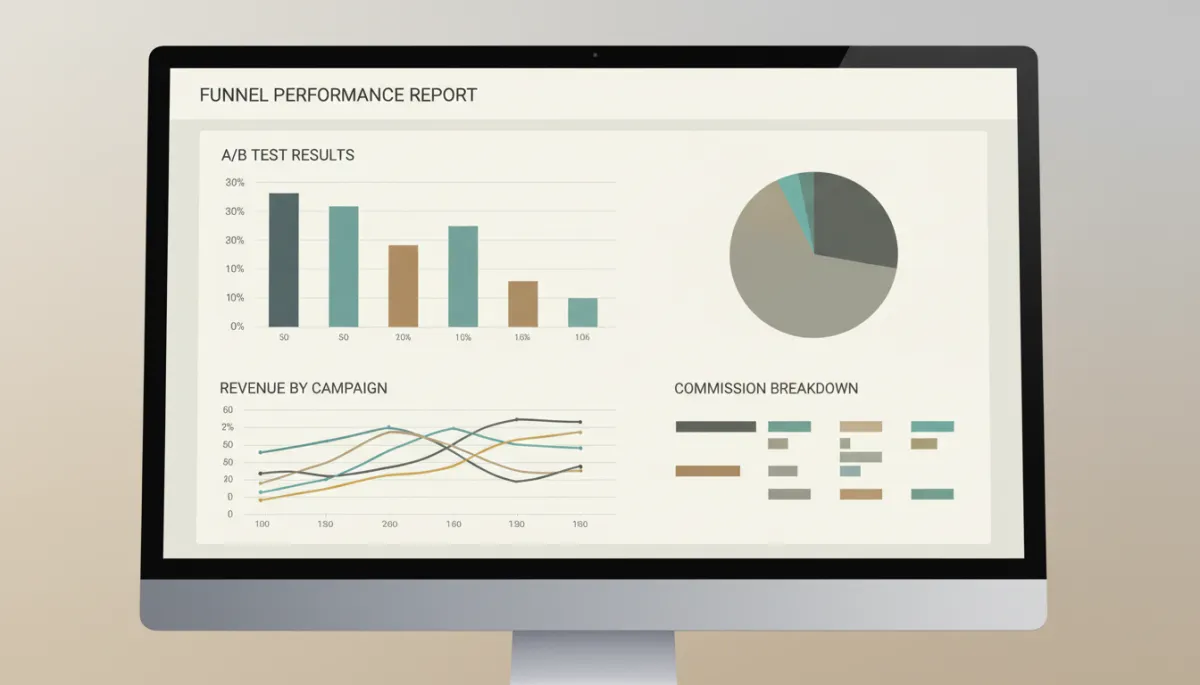
Structured analytics enable faster iteration on offers, creatives, and commission strategies.
For organizations concerned with commission management, Commission OS delivers value more indirectly. It does not function as a traditional commission‑tracking back office; instead, it focuses on the upstream layer—campaign ideation, asset generation, and action planning—that ultimately drives commissionable events. By standardizing how campaigns are launched and documented, it becomes easier for sales managers, or affiliate leads, to attribute performance to specific offers, creatives, and traffic channels. This, in turn, supports more rational commission structures, clearer expectations for partners, and data‑driven decisions about which campaigns warrant increased payout tiers or exclusive terms.
The limitations are important to surface. Commission OS does not handle network approvals, guarantee traffic, or automate compliance with individual platform policies (Click Now). AI‑generated content, while fast, can be formulaic and will typically require human editing to align with brand voice, platform norms, and regulatory standards. Moreover, the upsell sequence, although optional, can introduce decision fatigue for less experienced buyers. Teams should map their current sales and commission workflows first, then select only those add‑ons that solve a clearly defined bottleneck, such as funnel complexity, paid‑traffic scale, or agency licensing requirements.
The split‑testing emphasis on the launch page is, in itself, a positive signal. It indicates that the vendor is instrumenting their own sales funnel, measuring conversion deltas across pricing, guarantees, and positioning statements. For professionals, this suggests a culture of experimentation, and an understanding that sales performance is an ongoing optimization problem, not a one‑time design exercise. Buyers who adopt the platform with the same mindset—treating every campaign as a structured test, with clear hypotheses and metrics—are far more likely to extract meaningful ROI, and to build predictable commission pipelines over time.
In conclusion, Commission OS is a legitimate, AI‑assisted workflow platform that can materially accelerate the launch and iteration of CPA campaigns, especially for professionals who value speed, structure, and integrated tooling. It is not a substitute for sales strategy, traffic acquisition skills, or disciplined commission management. For sales‑oriented teams, the most pragmatic approach is to treat the $27 core offer as a low‑risk test of fit, validate that the workflow aligns with existing processes, and only then consider higher‑ticket upsells or the VIP bundle. Used in this way—as a catalyst for faster experimentation rather than a promise of effortless income—Commission OS can be a credible asset in a modern, performance‑driven sales stack.